

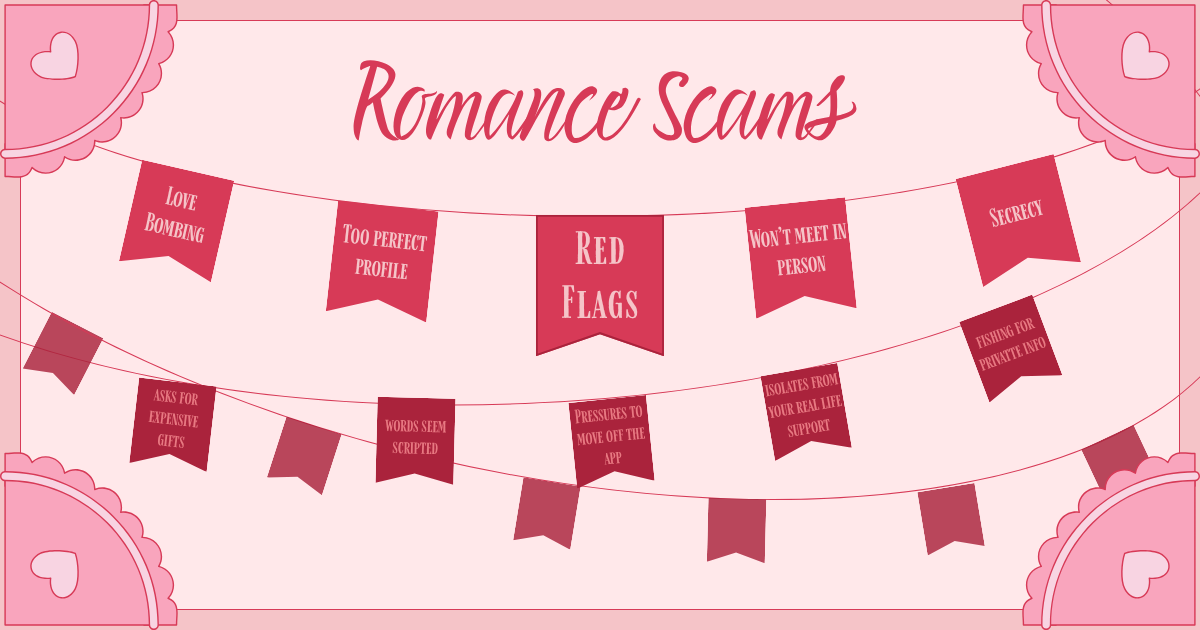
Romance Scams

People targeted by romance scams frequently feel shame surrounding being a "victim". Everyone thinks that "I would never be tricked by one of those scams" but the truth is anyone easily can be. In the most recent Internet Crime Complaint Center's annual report, romance or confidence scams are the 10th most reported crime but the report lists it 6th for the amount of money lost. Indicating that romance scams might not be as reported as frequently as some crimes like phishing or spoofing or even identity theft but the financial losses tend to be more devastating.
Scammers put a lot of effort into being convincing. It's not a sign of your intelligence that you chose to believe someone who was lying to and manipulating you. Particularly if they use romance to distract you. Love can make it hard to pick out red flags, you might not even recognize that they stole from you until it's too late.
Red Flags
Your romantic interest is quick to express love or too much affection too soon.
Saying things like "I've never felt this way before" or "I want to spend my life with you" within days or weeks of first meeting creates a sense of intimacy or connection that may turn out to be fake.
Scammers will use emotional manipulation to create a sense of urgency that doesn't allow you to think through their actions or any strange requests they make.
Your romantic interest pressures you to move off of the platform.
They might claim that it's "easier" or "more secure" but often scammers will try to move you to a platform that will make it hard to collect evidence of any crimes that they commit.
Your romantic interest is cagey about meeting in person.
Making and then canceling plans for meeting, especially at the last minute is a sign that they might have something to hide. If you haven’t met the person after a few months, no matter what their excuses are, you have good reason to be suspicious.
Scammers can also use meeting in person as a way to extract money from you. "I need money for a ticket to come meet you" and then "Something happened with my flight and I need money to get back home" is a convenient excuse especially when they never planned to meet with you in the first place.
Your romantic interest's profile is too perfect
Scammers will often use the same profile and script to target multiple people at the same time. Especially in the age of AI, if a profile looks too good to be true than it probably is.
Your romantic interest's language seems scripted or changes randomly.
If the person you're talking to uses strange and stilted words or phrases that might be a sign that they are using AI or a translator. They could just be copying and pasting from a script that they can use with anyone. It could even be multiple people pretending to be the same person.
Your romantic interest's stories are inconsistent or over-the-top sob stories.
Scammers try to manipulate your emotions by making you feel sorry for them. They will make up an Oscar-worthy backstory to get you invested
If details, like where they live or what they do for a living, randomly change with no explanation that could be a sign that they aren't being truthful. If the scammer is preying on multiple people, it's harder to be consistent and they might make mistakes.
Your romantic interest requests money or gifts.
While gift-giving can be a part of healthy relationships, scammers will pull on your heart strings to get money and expensive gifts. They might ask for large presents too early in the relationship. They might create an urgent crisis that only you can solve by giving them large sums of money. You will feel like their savior and they will have gotten whatever they were targeting you for.
Your romantic interest fishes for sensitive personal information.
Scammers can take any opportunity to make money off of you. They might seek out things like your social security number, your mother's maiden name, and other personal details that will allow them to steal your identity. They could take the opportunity to get close to you and discover things that they can use to blackmail you in the future.
Your romantic interest insists on secrecy or tries to isolate you from your friends and family.
One of the best defenses against romance scams is having a network of support in real life. If they're saying things like "People won't understand our love" or "[Your loved ones] are trying to break us up" they could be trying to separate you from people that can spot red flags that you might miss because you're emotionally invested.
Romance scams' red flags have become more difficult to spot since the arrival of AI. Artificial Intelligence can mimic a real person well enough that it's possible for a scammer to convincingly fake audio for phone calls and make a realistic avatar of a person for video calls. It used to be that we could tell you to call or facetime a person you met online to verify that who you're talking to is a real person. Now, a scammer could theoretically set up an AI to run the entire scam themselves. Your potential love interest contacts you on an app and convinces you to use some other messaging app. Turns out that it's actually an AI chat that's been prompted to say whatever you want to hear. The scammer doesn't need to do any work while the AI manipulates you.
Protecting yourself from Romance Scams
Go slowly.
Be cautious of how much personal information you share online.
Be wary of people who ask for too much too quickly.
Scammers rely on their targets not taking the time to think things through.
In real emergencies there are usually multiple solutions and there are people and legitimate organizations that can help.
Verify.
If you only know the person from the internet, take time to verify details of their stories.
Run their profile photos through a reverse image search and/or software that can verify if they are AI-generated.
Ask specific or unusual questions that can't be answered with a script. Real people will respond naturally, scammers will dodge or be vague.
If they claim to need money urgently ask yourself "Is money the only solution? Who else can help?"
Getting an outside perspective can reveal red flags if it's a fake emergency or help you find real solutions if it's a genuine one.
Trust your gut.
Communicate through platforms you know and trust.
Avoid clicking unfamiliar or suspicious links.
If you aren't sure if it's real, then don't send money in ways that can't be recovered or refunded.
Scammers will ask for things like cash, gift cards, or instant-transfer methods because they're hard to track.
Healthy relationships don't involve constant crises, secrecy, guilt trips, threats, or affection that hinges on conditions like money and gifts.
The Aftermath
Depending on what information the scammer has, you may need to take steps to secure your finances. Some protections can expire if fraud isn’t addressed within a “timely” window, but the specific steps someone takes will vary based on their comfort level and circumstances. The information in this section is meant to provide general guidance and awareness, not legal advice, and individuals sometimes choose to speak with a lawyer or advocate if they want help understanding their options.
It can be difficult to recoup losses without involving law enforcement. If you do choose to report, it is helpful to share how much money was lost (even if it's an estimated range) and write down the incident number assigned to the report. The documentation provided by a report can support any restitution claims you might make. Some losses may even be covered by insurance or VCAP (click here to learn more about VCAP), but those sources will likely ask for some sort of official report.
Law Enforcement Agencies people can report to include:
PA Office of the Attorney General
FTC
CFPB
FBI
Banks and credit card servicers can help check whether your accounts are still secure. In some cases, a bank may recommend closing accounts that have been compromised. Some scam victims have also submitted clemency letters requesting forgiveness for fraudulent purchases.
People have also found it helpful request a credit report to ensure that their identity hasn't been stolen and no unauthorized loans or credit cards have been opened in their name.
You may need to secure other online accounts too by changing passwords, setting up multifactor authentication, or checking for unusual activity.
Experiencing a romance scam can bring up feelings of shame, embarrassment, or grief. These reactions are extremely common but have the unfortunate effect of making victims hesitant to come forward. Scammers use psychological tricks designed to manipulate trust and emotions, and anyone can be targeted. Scammers come up with new sophisticated tactics all the time so it's important to be cautious and to rely on the people you know you can trust. Talking with trusted friends, family, an advocate, or a counselor can help process the conflicting feelings that arise when you've been the target of a scam.
Victim Services is here to help any victims of crime, including people who have been targeted by romance scams, no matter how long ago it happened or how much money was involved. Our staff understands how isolating and overwhelming this experience can feel, and you do not have to go through it alone.
We can listen to your story without judgment, talk through what happened, and help you sort out both the emotional and practical next steps. This may include connecting you with agencies that handle financial fraud, helping you understand reporting options, and pointing you toward safeguards that can protect your identity and accounts. We can also refer you to counseling, support groups, and legal or advocacy resources if you want them.
Even if you are unsure whether what happened “counts” as a crime, or you don’t want to involve law enforcement right now, you can still reach out. Victim Services can offer support, information, and connections to resources to help you regain a sense of safety, explore options for recovering what was taken, and begin to heal.
Sources
AG Sunday Warns Pennsylvanians to be Aware of Online Romance Scams During Valentine’s Day. (n.d.). Pennsylvania Office of Attorney General. Retrieved February 27, 2026, from https://www.attorneygeneral.gov/taking-action/ag-sunday-warns-pennsylvanians-to-be-aware-of-online-romance-scams-during-valentines-day/
Federal Bureau of Investigation, & Yarbrough, B. C. (2024). 2024 IC3 Annual Report [Report]. Retrieved February 27, 2026, from https://www.ic3.gov/AnnualReport/Reports/2024_IC3Report.pdf
Romance Scams. (n.d.). FBI. Retrieved February 27, 2026, from https://www.fbi.gov/how-we-can-help-you/scams-and-safety/common-frauds-and-scams/romance-scams
Spotting the Red Flags: Warning Signs of a Romance Scam. (n.d.). In santaclaracounty.gov. Retrieved February 27, 2026, from https://files.santaclaracounty.gov/exjcpb1631/2025-01/spotting-the-red-flags_warning-signs-of-a-romance-scam.pdf
What to know about Romance Scams. (2026, February 12). Consumer Advice. Retrieved February 27, 2026, from https://consumer.ftc.gov/articles/what-know-about-romance-scams